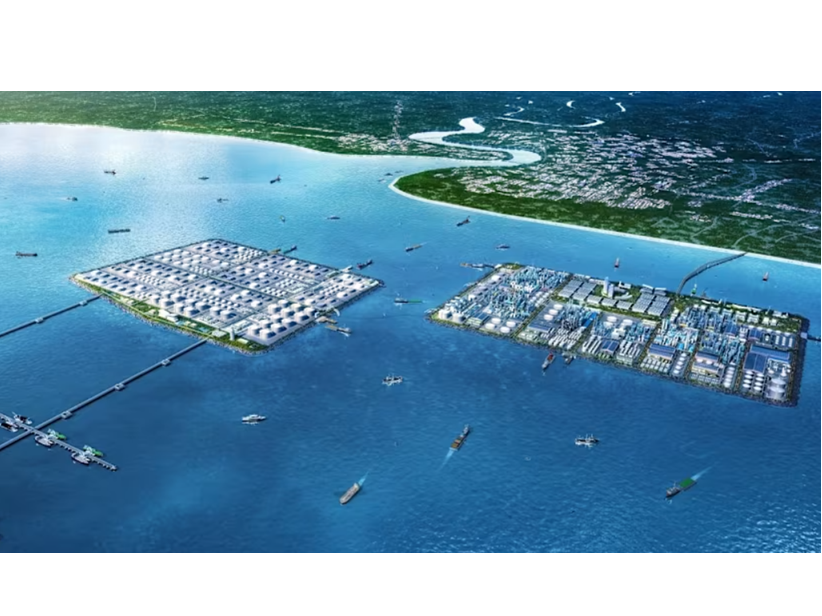
JOHOR BAHRU: Malaysia’s newly launched Maharani Energy Freeport in Johor is positioning itself as a deep-water alternative to Singapore, targeting the lucrative flow of oil tankers that make up one-fifth of global crude shipments through the Strait of Malacca.
Built on three purpose-built reclaimed islands off Muar, the project aims to develop into a zero-tax freeport for energy trading, storage, ship-to-ship (STS) operations and bunkering.
With natural water depths exceeding 24m, the hub is marketed as one of the few locations in the region capable of accommodating fully-loaded Very Large Crude Oil Carriers (VLCCs) without dredging.
A VLCC is a vessel designed to transport crude oil, capable of carrying around 200,000 to 320,000 tonnes of oil per voyage.
However, shipping and logistics experts told CNA that Maharani’s biggest challenge is competition in the region, including from its neighbour across the Johor Strait.
Singapore remains the world’s dominant bunkering and oil-trading hub, supported by major refinery complexes, decades of regulatory credibility and the presence of trading giants such as Shell, Trafigura and Vitol.
Nearby Indonesian anchorages around Batam, Karimun and Nipah (the Riau islands) have also carved out a strong niche for STS transfers, while storage facilities in Tanjung Uban (Bintan) attract tankers looking for cheaper re-export options.
Despite this, analysts say Maharani’s aggressive tax incentives — including zero corporate tax for most operators and a 3 per cent rate for oil traders — give it a pricing edge.
Maritime and logistics scholar Nazery Khalid told CNA that the launch of the freeport is evidence that Malaysia “no longer wants to be at the periphery of competition” and is offering a hub that could put it in direct competition with Singapore over the next decades.
“When you have a big facility like this – offering connectivity to the region and strong tax incentives, it will naturally attract shipping lines in the tanker trade, investors and players in the energy sector. They are drawn to freeports with such characteristics the way bees are attracted to nectar,” said Nazery who is also adjunct professor at three Malaysian universities.
But experts maintained that the port will need to boost infrastructure readiness and operational reliability before it can meaningfully draw traffic away from established rivals.
Reference : Could Johor’s new energy freeport compete against Singapore and other regional oil trade hubs? – CNA