The next 365 days are expected to be a whirlwind of activity for Johor as the state kicks off a line-up of events in conjunction with Visit Johor 2026 (VJ2026).
The state government aims to attract over 12 million tourists over the next 12 months, eyeing a massive economic spillover of more than RM42bil.
As part of the VJ2026 roadmap, some 60 international events will be held across all 10 districts.
The calendar is packed with crowd favourites, including the International Kite Festival in Pasir Gudang, which usually attracts tens of thousands of people from all over the world.
Other highlights are the annual Chingay Festival, World Chef Championship, Majestic Johor Fishing Competition, Majestic Johor International Golf Event, Festival Kraf Malaysia and the Kejora Monsoon Surf Festival.
To enable more visitors to travel to the state, KTM Bhd (KTMB) has doubled its Electric Train Service (ETS) frequency between Johor Baru and Kuala Lumpur from four – two each way – to eight trips daily.
The ETS service to the south, launched on Dec 12, covers the 192km Gemas-Johor Baru line and services 11 new stations – Segamat, Genuang, Labis, Bekok, Paloh, Kluang, Mengkibol, Rengam, Layang-Layang, Kulai and Kempas Baru.
With a maximum capacity of 312 passengers per six-coach train, more than 3,120 people can now travel between the nation’s capital and Johor Baru daily.
Travelling at speeds of up to 140kph, the service slashes travel time to just 4.5 hours, offering passengers in air-conditioned comfort scenic views of plantations and rustic townships.
Flood watch
However, the excitement is tempered by the monsoon season, which is expected to bring heavy rainfall and floods in low-lying areas until March.
Historically, Segamat and Kota Tinggi are usually the hardest hit; the great floods of 2006 and 2007 displaced over 100,000 people, while the 2011 floods affected almost 50,000.
At press time, dozens of people have been evacuated in Segamat, while river levels in Tangkak, Batu Pahat and Mersing have hit the danger zone.
Election talk
Other than the rain, political talk is also heating up.
Rumours are rife that Johor Mentri Besar Datuk Onn Hafiz Ghazi might call for a snap election mid-year, even though the present government’s term only ends in April 2027.
This speculation was fuelled by the many goodies announced for various segments of society, including civil servants and non-governmental organisations, during the state budget in November last year.
It is believed that Onn Hafiz is looking to capitalise on the “feel-good factor”, generated by the economic boom, particularly the Johor-Singapore Special Economic Zone (JS-SEZ).
The JS-SEZ blueprint, covering 11 sectors – logistics, manufacturing, financial services, business services, digital economy, tourism, food security, education, health, energy and the green economy – is expected to be unveiled in the first quarter of this year.
Spanning 3,588sq km, about four times the size of Singapore, the JS-SEZ comprises nine flagship zones – Johor Baru Waterfront, Iskandar Puteri, Tanjung Pelepas, Tanjung Langsat-Kong Kong, Senai-Skudai, Kulai-Sedenak, Desaru-Penawar, Forest City and Pengerang.
Enhanced travel network
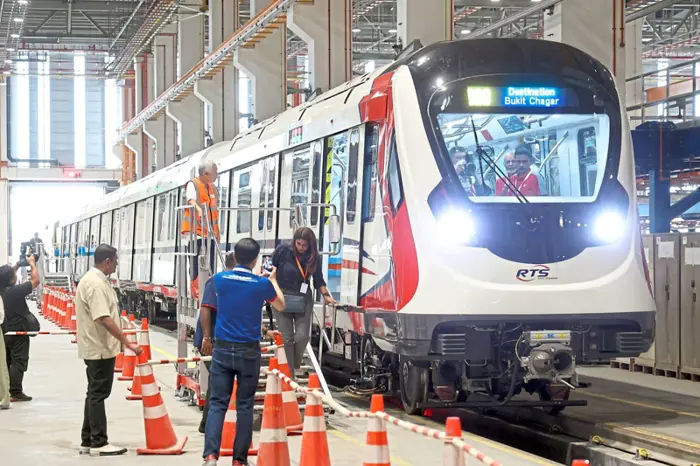
Connectivity will also be improved with the expected completion of the Johor Baru-Singapore Rapid Transit System (RTS) Link between the Johor capital and the republic, with operations slated to begin early 2027.
The 4km link between Bukit Chagar in Johor and Woodlands North in Singapore is projected to transport 10,000 passengers per hour in each direction.
RTS Operations Pte Ltd (RTSO) is a joint venture between Prasarana RTS Operations Sdn Bhd and SMRT RTS Pte Ltd.
The company owns, designs, builds and finances the operational assets of the RTS Link, including the trains, tracks and systems.
2025 in review
Looking back, 2025 was an eventful year for Johor, with the state making headlines in terms of economic prosperity, connectivity boost via infrastructure development, and sports.
The state also saw wildlife smuggling, massive traffic snarls at both land checkpoints with Singapore, and two major pollution cases affecting more than a million people in the southern part of the state and other areas, among other things.
Last year, Onn Hafiz said Johor was on track to achieve at least RM100bil in approved investments by year-end, having already secured RM56bil by the second quarter.
The completion of the Gemas-Johor Baru Electrified Double Track Rail Project (EDTP), costing RM8.9bil, after nine years was an important milestone for state connectivity, especially since it allowed for the start of ETS services between Johor Baru and Kuala Lumpur.
Football fans also had much to cheer about, enjoying two special public holidays (on April 28 and Dec 15) as Johor Darul Ta’zim (JDT) dominated the field, reaching the Malaysia Cup final in April and clinching the FA Cup in December.
However, the year was not without its troubles.
On Sept 16, three poachers were caught in Felda Tenggaroh, Mersing, with a female Malayan tiger carcass.
The animal had been snared and shot six times in the head.
The trio, including a cancer patient, were sentenced to seven years in jail and fined RM250,000 each.
Commuters also faced headaches in November when tighter security at the two Malaysia-Singapore land checkpoints led to thousands of motorcyclists queuing to clear immigration.
The congestion, which normally peaks around 6am and 7pm, began after border officials intensified checks following more than two dozen cases of Malaysians entering or leaving without passport checks.
Water security was another major issue as hundreds of thousands were forced to endure supply disruption due to two major incidents involving Sungai Johor.
More than 1.2 million people in four districts faced a five-day dry spell on Oct 31 after a bund silt pond collapse contaminated Sungai Johor with sludge.
The incident shut down the operations of four major water treatment plants.
The other incident occurred on May 20 when 300,000 people were left without water for four days after six pumps flooded at a water treatment plant in Kota Tinggi.
Nature and accidents also made the news.
A mild earthquake with a magnitude of 4.1 hit Segamat on Aug 24.
There were no reports of death or injuries in the incident which was also felt in Negri Sembilan, Melaka and southern Pahang.
Another mild earthquake measuring 3.4 was reported in Bukit Kepong, Pagoh, on Dec 28 with no reported injuries.
Elsewhere, a police helicopter crash in Sungai Pulai during a mock nuclear training exercise left five officers injured.
The Assistant Commissioner and Superintendent along with three rank and file personnel were sent to Hospital Sultanah Aminah for treatment.
A video of the helicopter spiralling and crashing into the water went viral.
Reference : Johor to drive growth via connectivity, investment | The Star